# Mapping Crypto: Part 1
- Author: Kojin Glick
- Published: 2022-08-02
- Canonical: https://www.kojinglick.com/blog/mapping-crypto-i
---
## A Long Time Coming
I've been poking at this project for a couple of months now. It started with a study of the petgraph crate to try to build a backend storage/graph builder service. A month or so later, I learned about Cloudflare's Ethereum Gateway. Since I have a couple of websites already using Cloudflare anti-DDoS services, I just attached a gateway to one of my domains. Finally, I got off my butt today to try to make at least _something_ that works.
## My Embarrasing Tangle of Tech
### Oak: a server engine for Deno
I'm. Learning. Deno. I don't know why I'm now insisting I do everything in Deno and Typescript, but so be it. Quickly ran through the Oak docs, and built a REST API relay for the ethereum gateway. This is an entirely unnecessary step which can be replaced by something in Actix Web or something. Right now, it gets the current block number, retrieves the transactions from the block and serializes the information into json for Rust.
### Petgraph Rust: building the graph
My main.rs is very simple. One function reads the json and deserializes it into Rust structs. Another turns those Rust structs into a node-based graph.
### Graphviz Dot Utility: gui is just svg
The laziest step is using Graphviz's Dot Utility to generate the graph.
This is what it looks like.
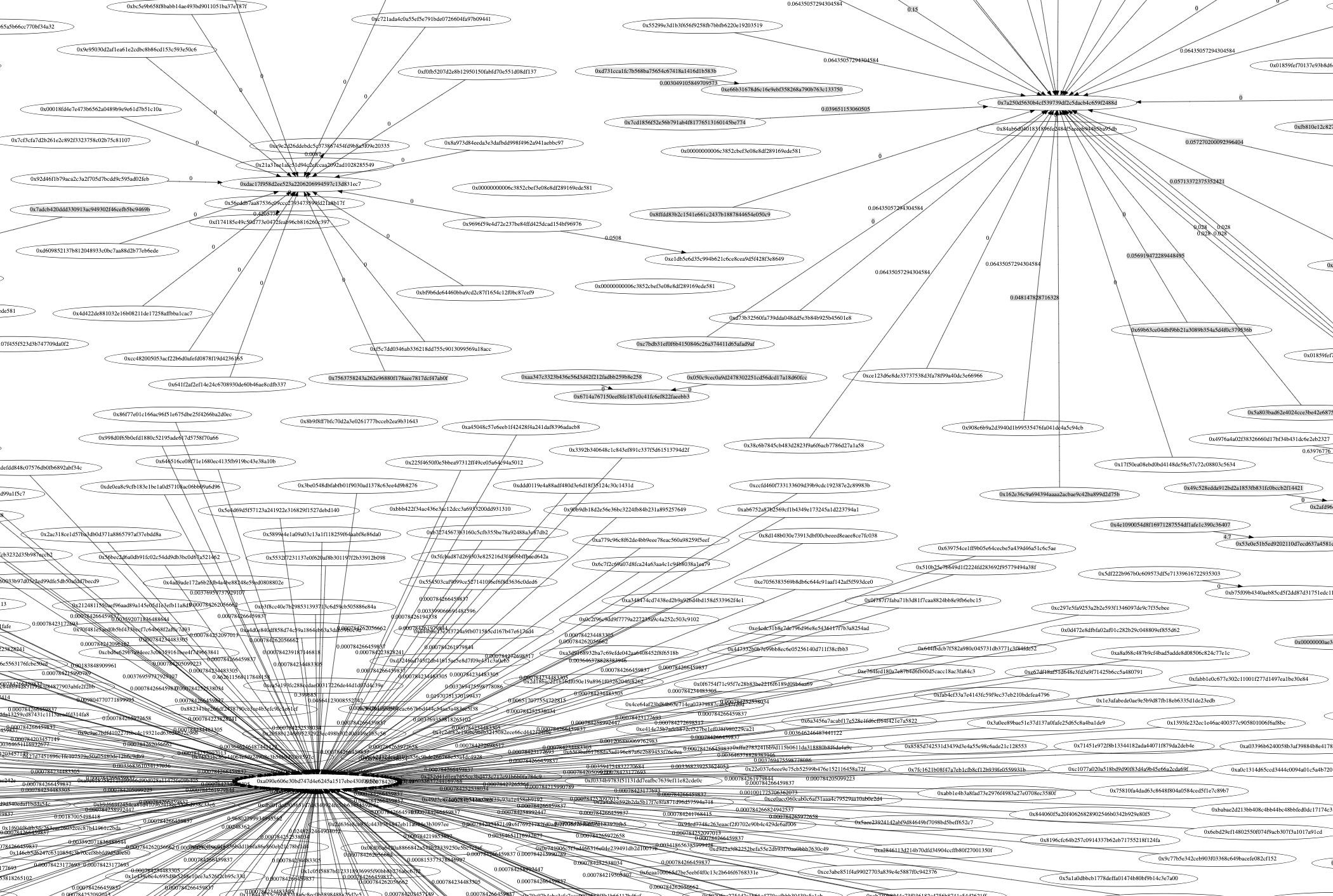
But, it exists. Next steps are replacing the Oak demo with a Rust service, and then using Typescript and Fresh or React for the front-end.